
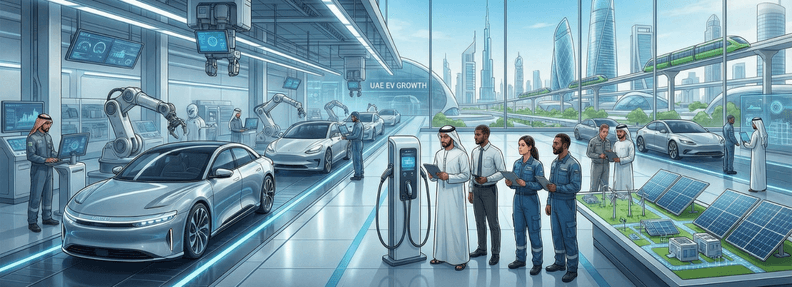
EV growth in the UAE: Shift creating jobs across multiple sectors
Table of Contents
- The national EV policy and vision
- Rapid progress since 2022
- Heavy infrastructure investment underway
- Manufacturing plants creating direct employment
- Multi-segment opportunities across sectors
- Clean energy sector benefits
- UAE positioning as regional export hub
- Why the next few years are critical
The national EV policy and vision
The national electric vehicles policy was issued in 2023 to create a roadmap for the electric vehicle charging sector, in collaboration with all partners at federal, local, and private sector levels. The policy's objectives include fostering industrial growth in the UAE, promoting the manufacturing of domestic electric vehicles, and generating job opportunities through green economy initiatives(1).
Rapid progress since 2022
The momentum is building quickly. According to Dubai Water and Electricity Authority, there were 25,929 electric vehicles in Dubai by the end of December 2023, a sharp increase from 15,100 EVs reported at the end of 2022(3). Market projections demonstrate explosive growth potential: market revenue of USD 2,220.7 million in 2024 is expected to reach USD 16,313.9 million by 2030(4).
The UAE offers compelling economics for EV adoption. The UAE ranks as the 4th most affordable country globally for EV charging, with drivers reducing fuel costs by 88% by switching to electric(5). Satisfaction with the overall charging experience stands at 95%(3), showing infrastructure quality matches ambition.
Heavy infrastructure investment underway
Infrastructure expansion is proceeding at scale. Dubai's DEWA aims to increase the city's network of public green charging stations by 170%, from 370 in 2023 to 1,000 by 2025(3). In Abu Dhabi, ADNOC and TAQA have set an ambitious target to install 70,000 EV charge points by 2030(3).
Dubai Roads and Transport Authority has committed to achieving emissions-free public transport by 2050(3), supported by the Dubai Clean Energy Strategy 2050 and Green Mobility Strategy 2030(3). Each charging station creates jobs in installation, electrical systems, maintenance, operations, and customer support—multiplying employment across the infrastructure network.
Manufacturing plants creating direct employment
Major manufacturing investments are materializing. Legend holding group is developing an integrated automotive hub worth AED 300 million at Dubai industrial city, spanning more than 1 million square feet(6). The project will create more than 700 jobs across sales, assembly line experts, engineers, servicing technicians, and back-office functions(6). The facility will assemble 15,000 EV and non-EV industrial motorcycles bearing the 'Made in UAE' brandmark annually(6).
Omega Seiki Mobility launched its first international electric vehicle assembly plant in Jafza, investing AED 92 million over five years(7). Spanning over 42,000 square feet, the facility is expected to commence assembly by the end of 2025(7). Additional investments include NWTN's EV assembly plant in Abu Dhabi in collaboration with Abu Dhabi ports, and Lightyear developing solar-powered vehicle concepts in Sharjah research, technology and innovation park(3).
PwC estimates that by 2030, EVs will have a market share of more than 15% (around 58,000 vehicles), while by 2035, the share will increase to 25%, equivalent to around 110,500 vehicles(3).
Multi-segment opportunities across sectors
EV job creation extends far beyond passenger cars. Market segmentation includes scooters, motorcycles, three-wheelers, passenger cars, buses, and trucks(4)—each requiring specialized manufacturing, maintenance, and sales expertise.
Infrastructure roles span charging station installation, operations, maintenance, and customer service. R&D centers dedicated to advancing EV technologies, improving manufacturing processes, and advancing skills of the local workforce through training programs and apprenticeships can drive innovation(3). After-sales services, spare parts distribution, and the pre-owned EV market create additional employment layers.
Collaboration with local industry associations, universities, and suppliers helps leverage expertise and resources to create a supportive ecosystem(3), generating education, training, and consulting opportunities.
Clean energy sector benefits
True emissions reduction requires clean electricity generation. Under the energy strategy 2050, the UAE is pursuing renewable and nuclear energy sources to achieve carbon neutrality by mid-century(3). Clean power generation targets include tripling renewable sources to 14 gigawatts, increasing clean energy capacity from 14.2 GW to 19.8 GW, and raising the share of clean energy generation to 32%, all by 2030(3).
As EV adoption increases electricity demand, it drives expansion of solar, nuclear, and other renewable energy infrastructure. This creates jobs in solar installation, nuclear operations, grid management, energy storage systems, and smart grid technologies. The relationship is circular: EVs drive clean energy growth, which enables more EV adoption, creating sustained employment across both sectors.
UAE positioning as regional export hub
The UAE leads the GCC in EV adoption and infrastructure development. With locally assembled vehicles bearing the 'Made in UAE' brandmark(6) and manufacturing plants strategically positioned, the UAE has potential to become a regional export powerhouse for EVs and components.
This export capacity requires skilled professionals across all related sectors—from manufacturing and quality control to logistics and international trade. Regional hub status creates sustained long-term employment opportunities beyond domestic market needs.
Why the next few years are critical
Government deadlines are approaching multiple 2030 targets and the 2050 goal of 50% EV adoption. Infrastructure expansion is in full action mode to meet these objectives. Current automotive professionals can transition from traditional to EV specializations.
Skills in EV technology, charging infrastructure, battery systems, and clean energy are highly transferable and increasingly valuable globally. Those who adapt to modern methods position themselves for decades of opportunity. The next 5-10 years are particularly crucial as infrastructure is built and manufacturing scales to meet rising demand.
For professionals across automotive, electrical, energy, and related sectors, the UAE's EV transformation represents unprecedented multi-sector opportunity. The question is whether you'll be among the professionals leading this transition or catching up later.
References
Related articles
NEW
Shape your long-term career vision with 3 simple questions
Careers today are shaped less by rigid ladders and more by evolving opportunities. In the GCC, industries are expanding, role...
Read more
How to assess your job readiness before applying
Many professionals begin applying for roles the moment they feel the urge for a change. While motivation is important, readiness matters more. Applying too early can lead to missed...
Read more
First 30 seconds can make or break your job call
Recruiters in the Gulf often decide in less than half a minute whether you are worth their time.With hundreds of candidates to call every day, they don't have time to guess. They n...
Read more